
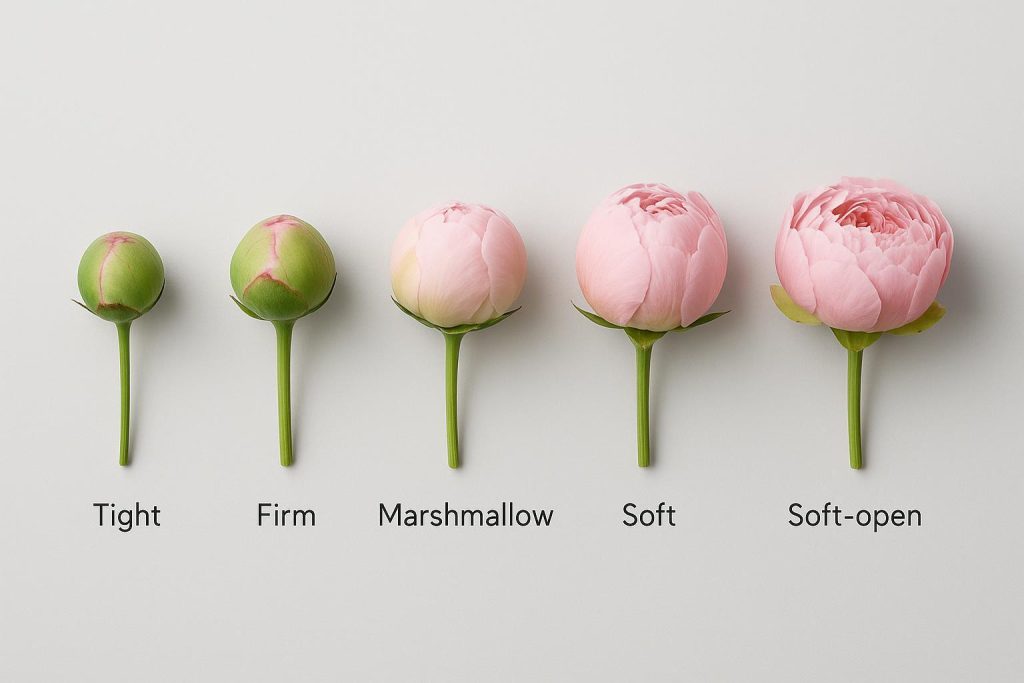
Peony programs live or die by bud maturity. The stage you buy at harvest governs transport stability, opening performance, vase life, and—ultimately—profitability. When multiple origins and suppliers are in play, a shared language for stages keeps everyone aligned, reduces rejects, and shortens training time. This guide standardizes the five common stages, explains tactile and visual identification, maps specs across Royal FloraHolland-style auction selling, North American supermarket programs, and wedding/event wholesale, and details conditioning, storage, shipping QA, and buyer inspection.
Primary goal: unify grading across multi-origins and multi-suppliers so buyers and growers specify the same thing, every time.
Stage ID: The Peony Bud Stages Tactile Firmness Scale (Including the Marshmallow Test)
Experienced growers rely on a finger-pressure test to judge harvest maturity. Hold the stem just below the bud, cradle the base with two fingers, and press the dome gently with your thumb. What you feel is your most reliable cue—especially when color show varies by variety.
Typical peony bud stages by feel:
- Tight bud: very firm; little to no give through the center
- Firm bud: firm with slight resilience at the outer petals
- Marshmallow: yields uniformly—like a fresh marshmallow—without a hard center (a common export target)
- Soft bud: noticeably soft; petals loosen easily
- Soft-open: outer petals starting to separate; suitable mainly for local sales
Why firmness matters: tighter cuts withstand long logistics but need more finishing time; softer cuts open faster but risk damage in transit.
According to the American Peony Society’s practical guidance in Cutting and Storing Peony Flowers for Later Use, the classic “fresh marshmallow” feel (no hard core) is a dependable signal for many doubles headed for export, while singles should be cut slightly firmer because they open faster. See the APS overview here: American Peony Society — Cutting and Storing Peony Flowers for Later Use (Hollingsworth).
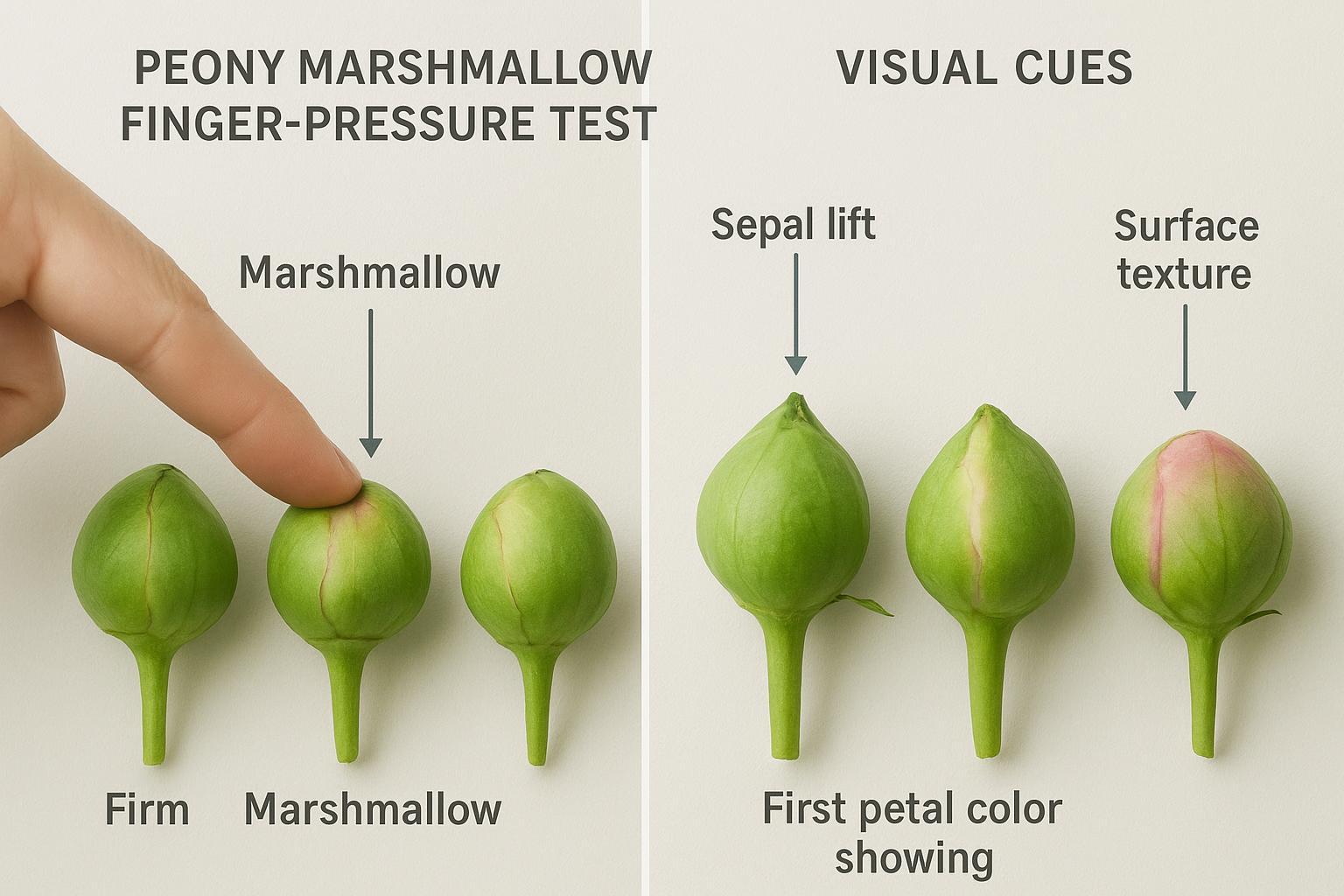
Tips to improve consistency across teams and suppliers: Standardize hand placement and pressure language in your SOPs; calibrate weekly by having two graders assess the same stems and compare notes; save annotated photos from each lot so remote buyers can verify stage prior to shipping (this mirrors Royal FloraHolland’s rules for flower photos for clarity in listings).
Visible Color and Sepal Cues
Visual cues support the tactile test and are easier to communicate in photos: sepal lift as the bud swells, a first sliver of petal color at the sepal split, diameter increase, and outer-petal texture shifting from hard/smooth to slightly satiny with faint creasing.
Caveats by variety: Singles often show color earlier relative to firmness and open fast; doubles may show minimal color at the same firmness and still be export‑ready; pale cultivars are harder to read by color alone—lean on the firmness test and include close-up verification images per Royal FloraHolland photography guidance.
Single vs. Double Peonies: How Form Changes the Spec
Not all peonies behave the same in storage and shipping. Form (single, semi-double, double) affects opening speed and the ideal purchase stage.
| Peony Type | Recommended Harvest Stage |
|---|---|
| Single Peonies | Firm bud |
| Semi-double | Firm to marshmallow |
| Double Peonies | Marshmallow stage |
Operational notes: Singles open quickest—buy a touch firmer if transit is long. Doubles are denser and slower—marshmallow is a common export target. Always validate by cultivar—there are outliers in every form. The “marshmallow” feel is described in APS practice here: APS — Cutting and Storing Peony Flowers for Later Use.
Buyer Specs & Grading
Standardizing Maturity Ranges
Create purchase specs that combine tactile and visual criteria with measurable bands: bud firmness (Tight/Firm/Marshmallow/Soft/Soft-open), diameter range and tolerance, color show descriptors, and sepal position. Use a short, illustrated appendix so every buyer and grower sees the same thing.
Illustrative maturity/grade reference for programs (training tool):
| 等級 | Bud Stage | Color Show | Shipping Suitability |
|---|---|---|---|
| Export Grade A | Marshmallow | Slight | Ideal |
| Export Grade B | Firm | Minimal | Acceptable |
| Retail Stage | Soft | Visible | Local markets |
For U.S.-bound programs, anchor size and defect language to the voluntary federal standard. The USDA Agricultural Marketing Service defines peony bud grades (U.S. No. 1 and No. 2) with minimum diameters, stem lengths, and tolerances you can incorporate into POs and acceptance sampling: USDA AMS — Cut Peonies in the Bud: Grades and Standards.
Specification template essentials (include in your PO or supplier agreement): variety/form and stage definition with a reference photo; size/length targets and tolerances; packing format (bunch count, horizontal orientation, sleeve/liner, pallet pattern); cold‑chain set points and logger placement; QA tolerances by defect class and a clear claim/rework workflow. For remote verification photos, mirror the clarity standards in Royal FloraHolland’s photo rules.
Hydration & Conditioning SOPs
Good hydration and sanitation reduce bacterial load and improve opening uniformity. Core steps after receipt or harvest include a fresh recut under clean water, stripping lower foliage below the waterline, and sanitizing containers. Avoid softened water where possible.
Hydration solution components commonly used in cut‑flower practice include a carbohydrate source, an acidifier to keep solutions slightly acidic, and a biocide to limit bacterial growth. A controlled‑environment trial reported by a major postharvest firm found that an ~18‑hour cold hydration pulse prior to storage/shipping increased vase life compared with non‑hydrated controls; evaluate products against plain water for your cultivars and document the outcomes: FloraLife — Peony Hydration Prior To Storage And Shipping Increases Vase Life.
Typical preconditioning flow (4–24 hours):
- Initial hydration in a sanitized container with pre‑chilled solution (≈34–36°F)
- Cold‑room stabilization at near 34–36°F with minimal handling
- Prep for packing and export (sleeve/liner on; dry exterior to avoid free water)
For grower‑level conditioning context and finishing reminders, see the APS overview: American Peony Society — Cutting and Storing Peony Flowers for Later Use.
Cold Storage Protocols
Routine 34–35°F Dry Storage (80–90% RH)
Short holds near 34–35°F with high humidity slow development without dehydrating buds. Keep lights low, ensure airflow around lined cartons, and avoid free water on petals. Species analogs from university postharvest programs (e.g., roses, delphinium) support near‑freezing storage with high RH and moisture‑retentive liners for many cut flowers; apply the same principles to peony programs and validate locally with logging.
Near‑freezing Long Holds (Program Caution)
Some programs attempt multi‑week holds near 0–1°C to extend the season. Outcomes depend on cultivar, sanitation, and moisture control. Because open‑access, peony‑specific, peer‑reviewed guidance is limited, treat any “12–16 weeks” claim as a hypothesis until you verify it with small test lots and robust logging.
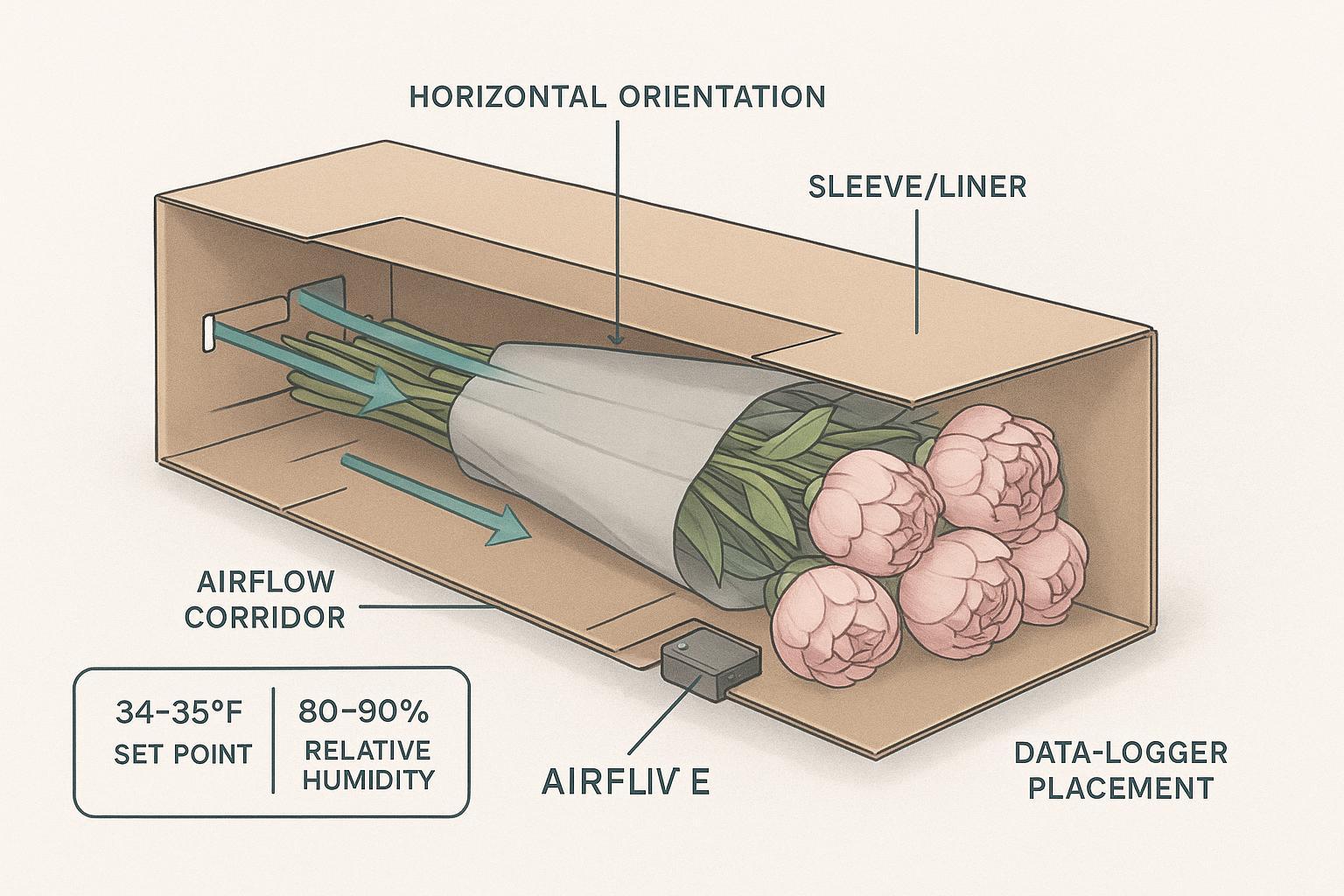
Practical set‑up reminders: Use horizontal orientation in lined sleeves to protect heads and keep stems straight; leave airflow corridors between bunches and avoid overpacking; place a data logger near the carton core and track temperature from pre‑cool to delivery.
Shipping, QA, and Risk Control
Packing, Orientation, and Ventilation
For long stems, horizontal packing in lined cartons limits bruising and curvature. Leave small gaps between bunches for airflow; avoid over‑compression that creates pressure marks.
Temperature Chain and Data Logging
Maintain an unbroken cold chain with documented set points. Place loggers in the center of the load and near doors to capture gradients. Record internal carton temperatures at receiving; keep audit trails to resolve claims.
Botrytis and Ethylene Avoidance
Botrytis risk rises with free moisture and warm temps. Rapid cooling, strict sanitation, high RH without condensation, and steady near‑freezing storage reduce incidence. Keep peonies away from ethylene sources (ripening produce, exhaust). For disease awareness and control context, see this extension‑linked summary: APS/WSU — A Grower’s Guide to the Most Common Diseases of Peony in the United States.
Buyer Inspection Checklist
Use this at receiving to standardize acceptance decisions and reduce disputes:
- Bud firmness vs. PO (Firm/Marshmallow) using the finger‑pressure test
- Visible color show and sepal position (note variety)
- Stem length/straightness and foliage condition
- Carton internal temperature and any condensation/free water
- Random‑sample finishing test: hydrate a subset to confirm opening in the target window
Bud Stage vs. Shipping Distance
Match purchase stage to logistics to avoid premature bloom or missed event timing:
| Shipping Distance | Recommended Bud Stage |
|---|---|
| Local delivery | Soft bud |
| Domestic transport | Marshmallow |
| International air freight | Firm to marshmallow |
| Long logistics routes | Firm bud |
Adjust by cultivar and season; hot lanes may require firmer cuts.
Stage-to-Open Planning by Bud Stage
Use these tendencies as a planning aid; validate on your cultivars and temperatures:
| Bud Stage | Typical Opening Time |
|---|---|
| Tight Bud | 4–6 days |
| Firm Bud | 3–5 days |
| Marshmallow | 2–3 days |
| Soft Bud | 1–2 days |
Ambient temperature during finishing is the biggest lever—warmer rooms open faster but can shorten vase life.
Conclusion
Standardized definitions for peony bud stages let buyers and growers speak the same language, especially across multiple origins and suppliers. Pair tactile and visual criteria, lock specs to your channel, hydrate and store with discipline, and document the cold chain with loggers. With a consistent inspection checklist and stage‑to‑logistics planning, you’ll reduce shrink and deliver predictable opening for retail programs and events.
Further reading (authoritative, non‑exhaustive):
- USDA Agricultural Marketing Service — Cut Peonies in the Bud: Grades and Standards
- American Peony Society — Cutting and Storing Peony Flowers for Later Use (Hollingsworth)
- Royal FloraHolland — Rules for Flower Photos
- FloraLife — Peony Hydration Prior To Storage And Shipping Increases Vase Life
- APS/WSU — A Grower’s Guide to the Most Common Diseases of Peony in the United States