

Color isn’t just a design choice in peonies—it’s a buying strategy. This 2026 guide is written for wholesale procurement and merchandising managers who need to translate demand for whites, blushes, corals, reds, and designer yellows into timely prebooks, realistic pricing, and reliable supply across hemispheres. We’ll connect what designers want to what buyers can secure, covering seasonality, grading and head size, storage and conditioning, pricing signals, and professional substitutions—without adding fluff.
Global Peony Color Trends 2026: What Buyers Are Seeing
Wedding programs still anchor demand, and that means whites and blushes lead in volume. Event designers continue to call out corals as a modern spring accent, reds for cultural and luxury programs, and rare yellows for statement palettes. Here’s how those preferences show up at the buying desk—and how to use them.
Wedding‑core whites and blush
Whites and blush peonies dominate bridal work because they read clean in photographs, soften large-scale compositions, and layer easily with other premium stems. Trade and wedding references consistently frame white and blush as perennial bridal anchors, even as styling cycles change year to year. Recent wedding editorials underline how white bouquets remain a staple while pastel palettes surge seasonally; see examples compiled by independent wedding publishers that continue to spotlight these palettes through 2025 trends coverage in the United States and Europe.
For industry context on U.S. bloom and grading notes (including an AAA bud size reference), John Deere’s The Furrow profiled peony operations and market expectations in 2025; it reinforces why premium whites and ivories remain core in wholesale programs according to the profile in the Deere publication Place Peonies (2025).
Coral as a modern spring accent
Coral cultivars like ‘Coral Charm’ and ‘Coral Sunset’ are visually electric at tight-to-early open, then mellow to apricot, peach, and even creamy blush as they mature. That shift matters to both designers and buyers: if a client wants a true coral pop, you’ll need earlier-stage product and tighter staging; if they want a softer peach, your receiving and conditioning window can be longer. This color evolution is documented in grower and garden trade references, including the 2024–2025 color trend features that tie peony tones to broader palette movements; see the discussion of peach-apricot transitions in Florissa’s 2024 color-in-blooms feature.
Event‑driven reds and cultural symbolism
Red peonies carry strong symbolism in many cultures and excel in high-contrast, large-venue work. Demand is episodic but intense. Buyers should plan for tighter windows and later cuts for some red varieties in the Northern Hemisphere, with slightly different holding behavior noted by growers during storage.
Niche yellows and novelty forms
True yellows and specialty forms are scarce, command premiums, and reward proactive prebooks. They won’t anchor a weekly standing order, but they can differentiate an event line if you’re willing to work across origins and accept variable volumes.
Seasonality & Global Supply Windows
Think in hemispheres and programs. In the Northern Hemisphere, U.S. Lower 48 farms concentrate in late spring; Alaska takes over later. The Netherlands and broader Europe deliver peak field product in May–June and can extend supply via storage programs. In the Southern Hemisphere, New Zealand and Chile support counter‑season imports for late‑year weddings and holiday events. If you keep a simple peony season calendar visible in your buying view, you’ll time prebooks and allocations more confidently.
- Northern vs. Alaska timing and U.S. field context appear across industry and wholesaler explainers; see the practical contrast between Lower 48 and Alaskan timing in the Flowermarketplace overview of Alaskan peonies (2025), plus a USDA story spotlighting operations and seasonal contrasts in the Farmers.gov feature on Rustic Peony (2024).
- Dutch leadership and programmatic extension are widely documented in florist and trade sources, including Ellermann’s regional guide and a Dutch retailer’s overview of year‑round availability strategies; see Ellermann’s guide to premier peony regions (2025) and Surprose’s discussion of year‑round peonies (2025).
- For counter‑season supply proof points, wholesaler content has documented December peonies sourced from New Zealand and Chile in Northern markets; see the WholeBlossoms note on December peonies (2025).
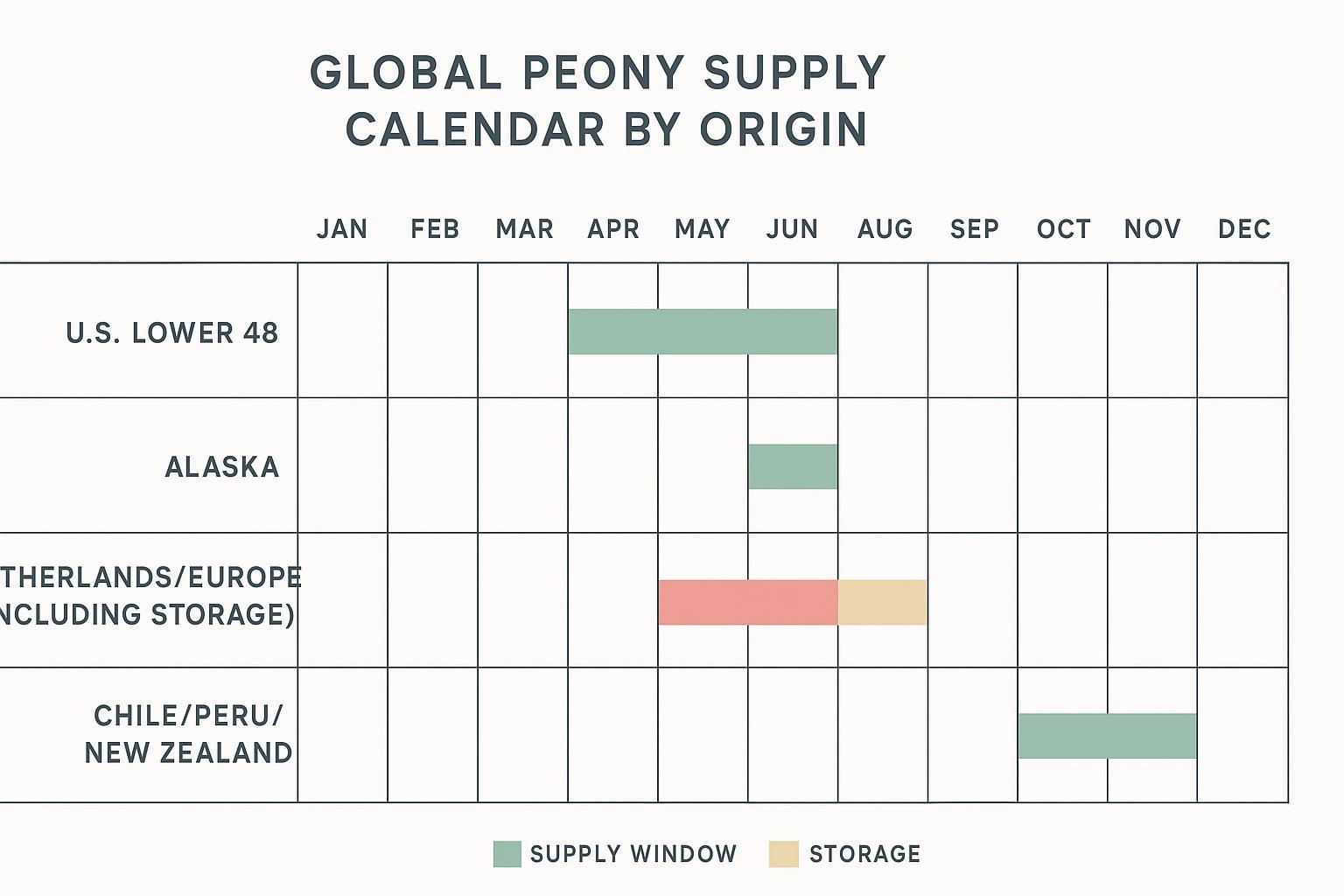
Below is a directional, procurement‑oriented table you can use to seed prebooks. Always verify exact ISO‑week availability with your suppliers and auction partners.
| Origin/Program | Likely window (Northern market availability) |
|---|---|
| U.S. Lower 48 (field) | Late Apr – Jun (regional early starts possible) |
| Alaska (field) | Late Jun – Jul (into early Aug for some farms) |
| Netherlands/Europe (field) | May – Jun (peak), with storage extension into Jul–Aug |
| Chile/Peru/New Zealand | Nov – Jan (counter‑season imports) |
Sourcing note: Week‑by‑week precision will vary. Northern farms may open earlier under warm springs; Dutch storage bands depend on cut stage, sanitation, and cold‑room capacity; and Southern Hemisphere flights drive landed costs and practical volume.
Peony Varieties by Color (Buyer Notes)
Blush and soft pink standouts
‘Sarah Bernhardt’ remains a late‑season workhorse for bridal palettes, with generous heads and a forgiving open. In early windows, blushes from European programs can backfill white‑heavy sets without pushing palettes too warm. Because blush is often specified alongside white, build ratio rules into your prebooks (e.g., 60/40 white/blush in peak wedding weeks) and flex the mix based on local event calendars.
Whites and ivories that anchor floral palettes
Classic whites like ‘Duchesse de Nemours’ and ‘Festiva Maxima’ continue to earn space on wholesale sheets thanks to strong head size, reliable open, and broad design compatibility. The market context and grading notes compiled in 2025 highlight how premium whites set expectations for head size and uniformity across channels; see the market snapshot in The Furrow’s Place Peonies (2025).
Buyer tip: When whites are allocated tightly, weigh Dutch storage product against domestic late fields—storage can fill gaps, but bud stage, sanitation, and transport history dictate how predictably stems will open on deadline.
Reds, corals, and designer yellows
Reds require concentration around cultural calendars, with plans for tighter windows and specific storage cautions. Corals should be booked early; if your designers want true coral, stage inventory for earlier uses before the palette shifts toward apricot and peach. For color‑shift context, review peony color evolution notes in Florissa’s 2024 feature. Yellows and novelties are limited and premium, so include alternates (Itoh hybrids or comparable forms) in quotes to protect margins when supply tightens.
Pricing and Availability Signals
Here’s the deal: to capitalize on peony color trends 2026 without eroding margin, you need clear expectations on where prices tighten and why.
In‑season baselines and wedding‑week premiums
In the Lower 48, prices typically ease during peak regional harvest, then tighten near major wedding weeks when design demand compresses. Alaska’s later season often sustains firm pricing into July. Auction‑linked European programs can oscillate more quickly around holidays and storage costs. Directionally, profiles of U.S. farms and auction markets confirm that head size, uniformity, and cut stage drive wholesale value; see the grading context in The Furrow profile (2025). Mention “peony wholesale pricing” explicitly when aligning internal dashboards so your team tags the right signals.
Practical move: Mirror your client calendar to regional peaks and pre‑sell whites/blushes in weekly blocks. Integrate contingency language for coral and novelty colors that are more variable.
Off‑season imports and logistics costs
Counter‑season imports (Nov–Jan) from New Zealand and Chile are real but capacity‑sensitive. Freight availability, transit times, and cold‑chain performance will feed directly into landed costs. Retail‑facing trade content has documented how December peonies reach Northern markets via Southern Hemisphere farms; review the planner‑oriented overview from WholeBlossoms (2025).
Grade, head size, and week‑based pricing
Bud diameter and stem length remain core price signals. Industry storytelling places AAA buds around the mid‑40 mm mark in premium channels, though exact grading language may vary by supplier and auction. That’s a useful heuristic when you communicate expectations with designers: bigger buds and longer stems will move quotes. Align on targets during prebooks to reduce last‑minute renegotiation; see the bud‑size context in the Deere publication (2025).
Professional Buying Playbook
Forecasting, prebooks, and color planning
Work backward from wedding weeks and cultural event dates. Map weekly color ratios to origin windows, then lock prebooks with tiered allocations (A: must‑have; B: preferred; C: alternates). Reserve coral early and confirm novelty/yellow quantities with explicit substitution rules in quotes. Some buyers use simple color‑planning tools or shared order lists to streamline prebooks across origins.
Receiving specifications and reconditioning
Your goal is to maximize open rate and head size while minimizing disease risk. Prioritize rapid cool‑down and storage near 1–2°C (34–36°F) for cut peonies; growers documenting long‑term storage stress the importance of removing field heat quickly, staging by cut maturity, and keeping sanitation tight. A grower SOP details temperature bands, varietal cautions (e.g., select reds), and storage discipline; review the practical steps in the Alaska Perfect Peony long‑term storage guide (2025). Pre‑storage hydration supports vase life. While peony‑specific public parameters vary, research updates from solution manufacturers reinforce the benefits of proper hydration and clean solutions as part of standard practice; see the general findings compiled in FloraLife Research Updates. Keep airflow active and humidity moderate; segregate lots by cut stage to avoid premature opening, and document QC points on intake (bud firmness, botrytis checks, stem cuts) with photos for any claims.
Substitutions by color and form
When peonies are short, prioritize visual stand‑ins that preserve palette and texture. Garden roses lead as the closest match for ruffled density and premium feel in whites and blush. Lisianthus and hydrangea can support volume at different price tiers, while ranunculus or select roses can help cover coral/red notes for smaller‑scale pieces. For yellows or novelty textures, dahlias and even designer‑grade carnations can deliver chroma and petal volume. A wholesaler’s guidance on peony lookalikes for out‑of‑season periods offers a practical shortlist; see the visual and handling guidance in Mayesh’s peony lookalikes overview (2025).
2026 Market Outlook
Demand: Weddings will remain the core driver for whites and blush, with corals continuing as a spring accent. Event programs should keep reds in rotation for cultural calendars, while yellows and novelties stay premium and scarce.
Supply: Expect another year where Europe leans on storage to stretch field peaks, while Alaska extends Northern Hemisphere availability into July and early August. Counter‑season imports from New Zealand and Chile will continue to service late‑year weddings and holiday programs, contingent on freight and cold‑chain capacity.
Product: Breeding and grower practices keep nudging head size and reliability upward, but execution still rules—cut stage, sanitation, and postharvest discipline make the difference between smooth opens and jarring misses.
Open question for buyers this year: Where will you place your storage bets—Dutch programs that bridge gaps, or deeper domestic allocations with tighter QC? The answer may vary by week, client mix, and freight confidence.
Conclusion
Peony buying in 2026 starts with color and ends with execution. Use peony color trends 2026 insights to shape weekly ratios, anchor whites/blush, prebook corals early, and treat yellows/novelties as premium, limited lines. Cross‑reference global windows—Lower 48 in late spring, Alaska in early summer, Dutch field plus storage, and Southern Hemisphere for November–January—to time allocations and set expectations. Tighten receiving and reconditioning SOPs, align grade and head‑size targets during quoting, and keep a substitution matrix ready so design intent survives real‑world supply. That’s how you protect margins and deliver the palettes your clients actually want.
References and further reading (selected):
- U.S. operations and market context, including grading note: John Deere’s The Furrow, Place Peonies (2025)
- Lower 48 vs Alaska timing: Flowermarketplace, Alaskan Peonies (2025)
- USDA storytelling on season context: Farmers.gov, Rustic Peony feature (2024)
- Dutch/European leadership and year‑round strategies: Ellermann, Premier Regions Guide (2025) and Surprose, Peonies All Year Round (2025)
- Long‑term storage SOP and temperature guidance: Alaska Perfect Peony, Storage Guide (2025)
- Coral color‑shift context: Florissa, Colour of the Year in Blooms (2024)
- Counter‑season imports: WholeBlossoms, December Peonies overview (2025)
- Substitutions and lookalikes: Mayesh, Peony Lookalikes (2025)