When to Place Wholesale Orders
The Peonies bloom within a defined seasonal window influenced by climate and growing region. In temperate Northern Hemisphere zones, field-grown peonies typically begin harvesting in April, reach peak production in May and June, and decline by early July. Higher-elevation regions may extend harvest slightly into mid-summer. In contrast, Southern Hemisphere supply generally runs from October through December, providing an off-season opportunity for certain international markets. Because peonies are not a year-round crop, wholesale availability, bud stage control, and pricing are closely linked to these harvest cycles. For bulk peony stems, aligning your purchase timeline with the bloom window ensures better variety selection, more stable grading, and reliable cold-chain export scheduling.
供應日曆
查詢每週供應情況 →注意:顯示的月份為典型參考,實際供應情況取決於來源地/計劃安排—請根據您的目的地索取日曆。
Typical Bloom Timeline by Region
Peony bloom season varies by climate, latitude, and elevation. Understanding regional harvest windows helps wholesale buyers plan bulk peony stem orders more accurately and align programs with natural production cycles. Below is a typical reference for major export origins.
- China: Main harvest from February to June. Early-season varieties begin in mid-to-late February, with peak export volume typically in May.
- Netherlands: Greenhouse and field production from May to July. Dutch peonies are often used for late-spring and early-summer European programs.
- Chile: Southern Hemisphere supply from October to December, providing off-season peony availability for Northern Hemisphere markets.
- Higher Elevation Regions: In some mountain-growing areas, harvest may extend slightly into July due to cooler temperatures.
Note: Exact bloom timing depends on annual weather patterns. For wholesale programs and export shipments, we recommend confirming availability 2–4 weeks in advance during peak demand periods.
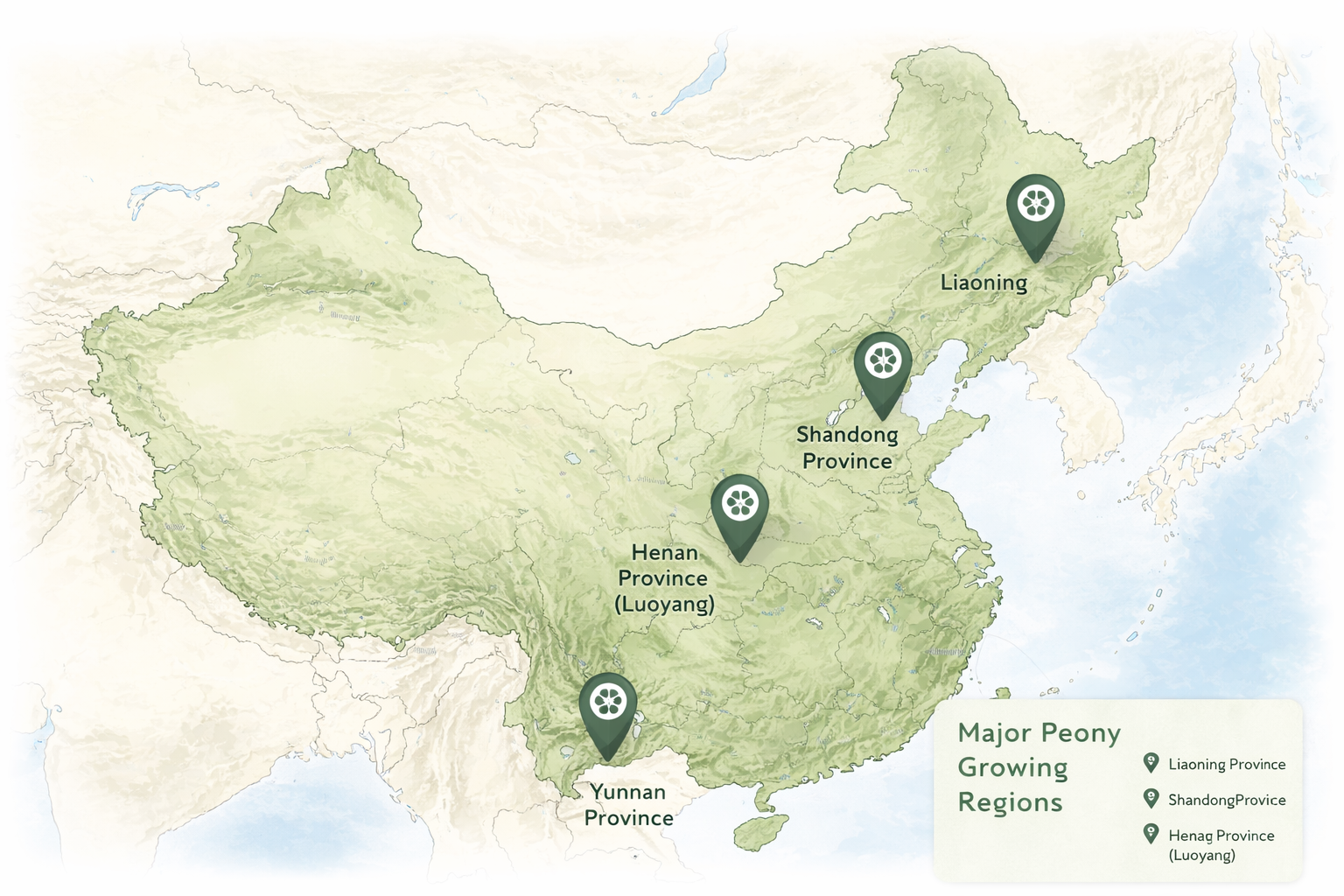
China Peony Growing Regions & Production Distribution
China is one of the primary global producers of fresh cut peonies, with large-scale commercial cultivation concentrated in temperate northern provinces. Regional climate, elevation, and winter chilling conditions directly influence harvest timing, stem strength, and bud development quality. Below is a general overview of major growing regions supplying wholesale export programs.
- Heze, Shandong Province: Often recognized as one of the largest peony cultivation centers in China. Main harvest runs from late April to May, with strong export volume for bulk peony stems.
- Luoyang, Henan Province: Known historically for peony production, with commercial harvest generally from late April to early June.
- Liaoning Province: Cooler northern climate supports slightly later harvest windows, often extending into June.
- Yunnan (High-Elevation Areas): Mountain regions with moderate temperatures can offer staggered bloom timing depending on altitude.
Bloom timing may vary by annual weather conditions. For wholesale peony export planning, regional staggered harvest helps extend overall supply windows within the natural seasonal cycle.
批發專案用新鮮切花芍藥
Fresh cut peonies are not typically purchased as a general inventory flower. They are program-driven products — meaning volume, bud stage, and packing must be aligned with a defined timeline.
Unlike roses or chrysanthemums, peonies have a narrow harvest window and a high sensitivity to temperature exposure. Bud stage at harvest, cold chain continuity, and destination climate together determine opening performance and vase life.
For structured wholesale buyers, planning usually falls into three main categories:
Bud stage at harvest, cold chain continuity, and destination climate together determine bloom timing and vase performance. For professional buyers, planning typically follows three structured procurement models:
1️⃣ Event-Based Procurement (Weddings & Installations)
Event florals require predictable bloom timing. Peonies must arrive at the correct bud firmness to allow controlled opening 24–72 hours before installation.
- Arrival temperature management
- Pre-event conditioning window
- Venue ambient temperature
- Variety-specific opening speed
Booking Recommendation: Confirm variety, stem length, and estimated arrival window at least 3–4 weeks before peak season.
2️⃣ Retail & Supermarket Weekly Programs
Weekly floral programs prioritize uniform bud stage, consistent grading, stable carton configuration, and shrinkage control.
- Uniform bud firmness per carton
- Structured stem length grading
- Controlled hydration format
- Minimized cold chain breaks
Improper temperature exposure during transit can cause uneven opening, accelerated blooming, and retail waste.
3️⃣ Florist & Importer Inventory Planning
For short-term wholesale inventory holding, bud stage selection is critical. Storage temperature directly impacts bloom speed.
- Recommended holding temperature: 0–2°C
- Bud stage allowing 2–4 days buffer
- Avoid exposure above 8–10°C
Temperature Impact Reference:
• Warmer environments → Faster opening + shorter vase window
• Cooler environments → Slower opening + extended holding potential
During peak spring season, bloom acceleration may increase by 30–40% when transit temperatures exceed recommended cold chain ranges. Structured wholesale flower cold chain management significantly reduces uneven opening and shrinkage in export programs.
Provide the Following for Program Alignment
- Destination country
- 預計到貨日期
- Event or retail launch date
- Required stem length
- Preferred color or variety
Based on your timeline, we align harvest bud stage, pre-cooling protocol, hydration format, and freight allocation to ensure bloom performance matches your commercial schedule.
Peony Bud Stage Classification Guide
Bud stage selection is one of the most important factors in wholesale peony programs. The correct firmness level determines opening speed, event timing control, vase life potential, and overall performance after cold chain transit.
Tight Bud
Firm and compact bud structure with limited visible petal separation. Ideal for buyers who require controlled opening over multiple days.
- Best for early booking programs
- Allows maximum timing control
- Suitable for events with lead time
- Slower natural opening after arrival
Recommended For: Weddings with preparation time, structured retail programs.
Marshmallow Bud
Medium firmness with slight softness when gently pressed. This is the most commonly selected stage for wholesale distribution.
- Balanced opening speed
- Stable for program supply
- Works well for 2–4 day holding
- Flexible across climates
Recommended For: Weekly florist supply, hotel rotations, retail inventory.
Soft Bud / Opening Stage
Advanced development stage with visible petal expansion. Designed for buyers who need faster show-ready appearance after arrival.
- Faster bloom timing
- Shorter holding window
- Requires careful temperature control
- Best for tight event schedules
Recommended For: Installations with limited processing time.
Temperature, hydration management, and destination climate directly influence opening speed. For optimal results in wholesale peony programs, bud stage should always be aligned with arrival date and intended usage timeline.
芍藥買家通常會優化的要素
買家通常根據以下一個(或多個)目標來選擇芍藥。告訴我們最重要的目標,我們將根據此匹配品種/花苞階段/包裝。
- 安裝當日開花狀況: 為了達到“展示準備就緒”的時間,優先考慮花苞階段和處理時間。
- 多日控制開花: 選擇更緊密的花苞階段,並計劃水分補充和降溫步驟。
- 顏色一致性: 品種固定或在顏色範圍內允許經批准的替代品。
- 處理速度: 團隊的接收人力有限時,包裝形式變得尤為重要。
如何指定芍藥規格(快速報價欄位)
為了準確報價並避免反覆詢問,請發送完整的規格清單。最佳格式:品種/顏色、莖長 + 等級、花苞階段、數量、目的地、到達時間範圍、事件/使用日期、包裝、替代規則。
- 品種 / 顏色: 품종을 나열해주세요(선호하는 품종)。如果您只知道色板,請提供「粉色系列 / 僅白色」+ 比例。
- 莖長及等級: 花瓶高度與設計風格(中央裝飾 vs 重要裝飾)相匹配的範圍。
- 花苞階段: 緊實 / 中等 / 開放(時間調整)。如果知道處理時間和冷藏溫度,也請一併提供。
- 數量: 品種別(最佳)或依顏色範圍的總數。如果可能,請加入可接受的+/-彈性。
- 目的地 + 到達時間範圍: 城市/機場/接收時間。「必須在此時間前到達」是最有幫助的信息。
- 活動/使用日期: 即使您不是活動買家,也請告訴我們需要「展示準備就緒」的花枝日期。
- 包裝: 花束 + 袋 / 紙箱 / 混合箱;如果要分發到團隊/房間,請要求 區域標籤。
- 替代規則: 不接受替代 / 僅限同品種 / 同色系可接受 / 僅在批准的情況下才可替代。
花苞階段與時機(簡明指南)
花苞階段的選擇會決定到達後開放的速度。根據您的時間表倒推選擇:到達日 → 處理日 → 設計日 → 活動日。溫度和水分補充會加速或延緩開放,因此任何關於您的SOP(標準操作程序)的細節將幫助我們提供正確的建議。
- 緊急: 當你有時間處理並且想要控制時,最為適合;通常選擇有提前準備時間的活動。
- 中等: 最靈活的「程式」階段;透過標準處理穩定開啟。
- 開場: 到達後需要快速準備好呈現效果時最為適合(處理時間有限)。
實用提示: 告訴我們您的冷卻流程(重新水合作業時間、典型的冷卻器溫度,以及您的團隊設計時間)。我們可以推薦最適合您處理現實的階段。
莖長與等級: 購買者如何選擇
莖長和等級會影響視覺效果和成本。 如果您不確定,請描述您的使用情境:中心擺設與大型安裝、花瓶高度,以及您是否想要“緊實”或“通透”的體積。
- 40–50cm: 對於中心擺設和大宗計劃非常高效。
- 50–60cm: 適合大多數花藝供應需求的平衡長度。
- 60–70cm+: 引人注目的設計和高型容器的高級外觀。
- 等級指南: 如果您對頭部大小有嚴格的期望,請註明;否則我們將根據程序的可用性提出可行的選項。
包裝與冷鏈注意事項(實際上防止問題的措施)
牡丹在穩定的冷鏈運輸和收到後快速補水時表現最佳。如果您的收貨團隊人手不多,包裝方式可以節省幾小時的時間。如果您正在運營活動或酒店計劃,我們可以根據您的分發計劃調整包裝。
- 束花 + 套筒: 保護花頭並加速接收/處理過程。
- 單一 SKU 箱: 當程序鎖定品種時,最容易進行庫存管理。
- 混合箱: 當調色板比例和替代規則事先定義時最為適合。
- 區域標籤: 建議用於多房間安裝和酒店輪換。
收貨與處理 SOP(簡單的清單)
如果您想要穩定的開箱並盡量減少損壞,買家在到貨當天通常會遵循以下步驟:
- 檢查與計數: 檢查箱子是否有熱損害和壓縮痕跡;如果有提供,請確認品種/標籤。
- 水合作業: 莖部重新修剪並放入乾淨的水中;避免將莖部放在溫暖的房間中乾燥。
- 溫度控制: 保持冷鏈穩定;大幅溫差可能導致不均勻開箱。
- 開箱計劃: 如果莖部過緊,允許進行控制的加熱/處理;如果過於打開,保持冷藏並減少處理。
替代規則: 避免驚訝。
供應可能會根據來源和計劃日程有所變動。如果您允許替代品,請在清單中明確定義它們:“僅相同品種” vs “相同色系可” vs “僅在批准後替代”。這樣可以防止最後一刻的錯誤匹配。
交貨時間與訂單規劃(該寄送的物品 + 寄送時間)
如果您正在建立每週計劃或鎖定活動色盤,及早發送正確的資訊將有助於我們匹配供應和時機。最快的流程是:發送規格 → 我們確認可行的選項 → 您批准替代品(如有) → 我們確認包裝和到達計劃。
顯示第 1 至 9 項結果,共 32 項