When to Place Wholesale Orders
The Peonies bloom within a defined seasonal window influenced by climate and growing region. In temperate Northern Hemisphere zones, field-grown peonies typically begin harvesting in April, reach peak production in May and June, and decline by early July. Higher-elevation regions may extend harvest slightly into mid-summer. In contrast, Southern Hemisphere supply generally runs from October through December, providing an off-season opportunity for certain international markets. Because peonies are not a year-round crop, wholesale availability, bud stage control, and pricing are closely linked to these harvest cycles. For bulk peony stems, aligning your purchase timeline with the bloom window ensures better variety selection, more stable grading, and reliable cold-chain export scheduling.
Availability Calendar
Ask for weekly availability →Note: months shown are a typical reference. Exact availability depends on origin/program schedule—request a calendar for your destination.
Typical Bloom Timeline by Region
Peony bloom season varies by climate, latitude, and elevation. Understanding regional harvest windows helps wholesale buyers plan bulk peony stem orders more accurately and align programs with natural production cycles. Below is a typical reference for major export origins.
- China: Main harvest from February to June. Early-season varieties begin in mid-to-late February, with peak export volume typically in May.
- Netherlands: Greenhouse and field production from May to July. Dutch peonies are often used for late-spring and early-summer European programs.
- Chile: Southern Hemisphere supply from October to December, providing off-season peony availability for Northern Hemisphere markets.
- Higher Elevation Regions: In some mountain-growing areas, harvest may extend slightly into July due to cooler temperatures.
Note: Exact bloom timing depends on annual weather patterns. For wholesale programs and export shipments, we recommend confirming availability 2–4 weeks in advance during peak demand periods.
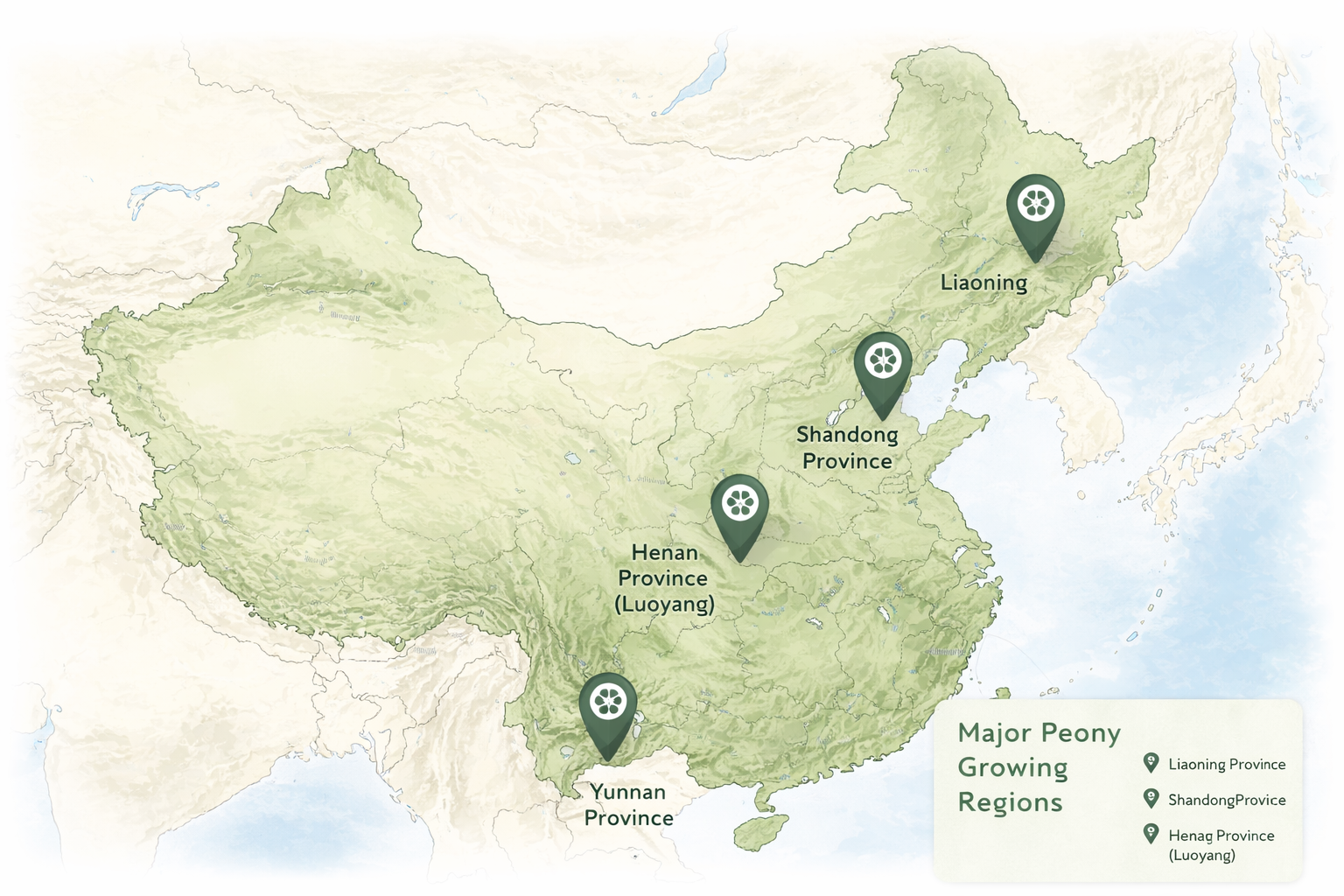
China Peony Growing Regions & Production Distribution
China is one of the primary global producers of fresh cut peonies, with large-scale commercial cultivation concentrated in temperate northern provinces. Regional climate, elevation, and winter chilling conditions directly influence harvest timing, stem strength, and bud development quality. Below is a general overview of major growing regions supplying wholesale export programs.
- Heze, Shandong Province: Often recognized as one of the largest peony cultivation centers in China. Main harvest runs from late April to May, with strong export volume for bulk peony stems.
- Luoyang, Henan Province: Known historically for peony production, with commercial harvest generally from late April to early June.
- Liaoning Province: Cooler northern climate supports slightly later harvest windows, often extending into June.
- Yunnan (High-Elevation Areas): Mountain regions with moderate temperatures can offer staggered bloom timing depending on altitude.
Bloom timing may vary by annual weather conditions. For wholesale peony export planning, regional staggered harvest helps extend overall supply windows within the natural seasonal cycle.
Fresh Cut Peonies for Wholesale Programs
Fresh cut peonies are not typically purchased as a general inventory flower. They are program-driven products — meaning volume, bud stage, and packing must be aligned with a defined timeline.
Unlike roses or chrysanthemums, peonies have a narrow harvest window and a high sensitivity to temperature exposure. Bud stage at harvest, cold chain continuity, and destination climate together determine opening performance and vase life.
For structured wholesale buyers, planning usually falls into three main categories:
Bud stage at harvest, cold chain continuity, and destination climate together determine bloom timing and vase performance. For professional buyers, planning typically follows three structured procurement models:
1️⃣ Event-Based Procurement (Weddings & Installations)
Event florals require predictable bloom timing. Peonies must arrive at the correct bud firmness to allow controlled opening 24–72 hours before installation.
- Arrival temperature management
- Pre-event conditioning window
- Venue ambient temperature
- Variety-specific opening speed
Booking Recommendation: Confirm variety, stem length, and estimated arrival window at least 3–4 weeks before peak season.
2️⃣ Retail & Supermarket Weekly Programs
Weekly floral programs prioritize uniform bud stage, consistent grading, stable carton configuration, and shrinkage control.
- Uniform bud firmness per carton
- Structured stem length grading
- Controlled hydration format
- Minimized cold chain breaks
Improper temperature exposure during transit can cause uneven opening, accelerated blooming, and retail waste.
3️⃣ Florist & Importer Inventory Planning
For short-term wholesale inventory holding, bud stage selection is critical. Storage temperature directly impacts bloom speed.
- Recommended holding temperature: 0–2°C
- Bud stage allowing 2–4 days buffer
- Avoid exposure above 8–10°C
Temperature Impact Reference:
• Warmer environments → Faster opening + shorter vase window
• Cooler environments → Slower opening + extended holding potential
During peak spring season, bloom acceleration may increase by 30–40% when transit temperatures exceed recommended cold chain ranges. Structured wholesale flower cold chain management significantly reduces uneven opening and shrinkage in export programs.
Provide the Following for Program Alignment
- Destination country
- Target arrival date
- Event or retail launch date
- Required stem length
- Preferred color or variety
Based on your timeline, we align harvest bud stage, pre-cooling protocol, hydration format, and freight allocation to ensure bloom performance matches your commercial schedule.
Peony Bud Stage Classification Guide
Bud stage selection is one of the most important factors in wholesale peony programs. The correct firmness level determines opening speed, event timing control, vase life potential, and overall performance after cold chain transit.
Tight Bud
Firm and compact bud structure with limited visible petal separation. Ideal for buyers who require controlled opening over multiple days.
- Best for early booking programs
- Allows maximum timing control
- Suitable for events with lead time
- Slower natural opening after arrival
Recommended For: Weddings with preparation time, structured retail programs.
Marshmallow Bud
Medium firmness with slight softness when gently pressed. This is the most commonly selected stage for wholesale distribution.
- Balanced opening speed
- Stable for program supply
- Works well for 2–4 day holding
- Flexible across climates
Recommended For: Weekly florist supply, hotel rotations, retail inventory.
Soft Bud / Opening Stage
Advanced development stage with visible petal expansion. Designed for buyers who need faster show-ready appearance after arrival.
- Faster bloom timing
- Shorter holding window
- Requires careful temperature control
- Best for tight event schedules
Recommended For: Installations with limited processing time.
Temperature, hydration management, and destination climate directly influence opening speed. For optimal results in wholesale peony programs, bud stage should always be aligned with arrival date and intended usage timeline.
What Peony Buyers Usually Optimize For
Buyers usually choose peonies based on one (or more) of the following goals. Tell us which one matters most, and we'll match varieties / bud stage / packing accordingly.
- Open look on install day: prioritize bud stage + processing time to hit "show-ready" timing.
- Controlled opening over multiple days: choose tighter stages and plan hydration/cooler steps.
- Color consistency: lock variety or allow approved substitutes within a color family.
- Speed of processing: packing format matters when your team has limited receiving labor.
How to Spec Peonies (Fast Quote Fields)
To quote accurately without back-and-forth, send one complete spec list. Best format: Variety/Color, Stem Length + Grade, Bud Stage, Qty, Destination, Arrival Window, Event/Usage Date, Packing, Substitution Rules.
- Variety / Color: list varieties (preferred). If you only know palette, give "pink family / white only" + ratios.
- Stem length & grade: pick the range that matches vase height and design style (centerpiece vs statement).
- Bud stage: Tight / Medium / Opening (timing lever). Include your processing time and cooler temperature if known.
- Quantity: per variety (best) or total by color family. Add allowable +/- flexibility if you can.
- Destination + arrival window: city/airport/receiving hours. "Must arrive by" is the most helpful line.
- Event/usage date: even if you're not an event buyer, tell us when you need "display-ready" stems.
- Packing: bunch + sleeve / cartons / mixed box; request area labels if you're distributing to teams/rooms.
- Substitution rules: no substitutes / same variety only / same color family ok / substitute only if approved.
Bud Stage & Timing (Plain-English Guide)
Bud stage selection determines opening speed after arrival. Choose backwards from your timeline: arrival day → processing day(s) → design day → event day. Temperature and hydration can accelerate or slow opening, so any details about your SOP help us advise correctly.
- Tight: best when you have time to process and want control; usually chosen for events with lead time.
- Medium: the most flexible "program" stage; opens reliably with standard processing.
- Opening: best when you need a faster show-ready look soon after arrival (limited processing time).
Practical tip: tell us your cooler workflow (rehydration hours, typical cooler temp, and when your team designs). We can recommend the stage that best matches your processing reality.
Stem Length & Grade: How Buyers Choose
Stem length and grade affect visual impact and cost. If you're unsure, describe your use case: centerpieces vs large installs, vase height, and whether you want "tighter" or "airy" volume.
- 40–50cm: efficient for centerpieces and high-volume programs.
- 50–60cm: balanced length for most florist supply needs.
- 60–70cm+: premium look for statement designs and tall vessels.
- Grade guidance: if you have strict head size expectations, note it; otherwise we'll propose workable options by program availability.
Packing & Cold-Chain Notes (What Actually Prevents Problems)
Peonies perform best with consistent cold chain and fast hydration on receipt. If your receiving team is small, packing style can save hours. If you're running events or hotel programs, we can align packing to your distribution plan.
- Bunch + sleeve: protects heads and speeds receiving/processing.
- Single SKU cartons: easiest for inventory control when programs lock varieties.
- Mixed boxes: best when palette ratios + substitution rules are defined in advance.
- Area labels: recommended for multi-room installs and hotel rotations.
Receiving & Processing SOP (Simple Checklist)
If you want consistent opening and minimal damage, these are the common steps buyers follow on arrival day:
- Inspect + count: check cartons for heat damage and compression; confirm variety/labels if provided.
- Hydrate: recut stems and place into clean water; avoid leaving stems dry in warm rooms.
- Temperature control: keep cold chain stable; large swings can force uneven opening.
- Plan opening: if stems are too tight, allow controlled warming/processing; if too open, keep cooler and reduce handling.
Substitution Rules (Avoid Surprises)
Availability can shift by origin and program calendar. If you allow substitutes, define them clearly in your list: "same variety only" vs "same color family ok" vs "substitute only if approved". This prevents last-minute mismatches.
Lead Time & Program Ordering (What to Send + When)
If you're building a weekly program or locking an event palette, sending the right info early helps us match supply and timing. The fastest process is: send spec → we confirm workable options → you approve substitutions (if any) → we confirm packing + arrival plan.
Showing 10–18 of 32 results